Thursday, 28 July 2011

The Cork Playground Smoking Ban, and the Dangers of Taboo

Several county councils are apparently considering banning smoking in playgrounds, and the topic has already come up for discussion in Cork County Council, where it appears likely that a bylaw is to be passed to that effect, perhaps as early as September. Councillor Deirdre Forde has brought the matter to her council, inevitably at the instigation of ASH (Action on Smoking and Health) Ireland. The reasons Councillor Forde gives are three:

1 The dangers of second-hand smoke for young children
2 The probability of children imitating behaviour they had seen from adults
3 The cost to the council of cleaning up cigarette butts.


I'm primarily interested in the second reason, or non-reason, as I deem it, but briefly on the other two: the theory of second-hand smoke being dangerous in an outside environment seems an untenable one, especially as the parents smoke on the margins of the playground, rather than in the vicinity of the playing children. Forde admitted that councillors had asked for more data on this problem, and I would guess that data will not be forthcoming, as any link between this type of "exposure" to second-hand smoke and health problems is unlikely to exist, as there is simply too much distance between, and fresh air around, the smokers and the children. The third reason is one that has nothing to do with smoking, as it could just as easily apply to the cost of cleaning up food wrappers or any other kind of litter. It's a littering issue, and is provided for under the law as such.

The Effects of Taboo

But what gets on my nerves is this idea of the imitativeness of children: smoking in playgrounds is to be banned because children must not see adults smoking. To quote Councillor Forde: "We must avoid passing on this learned behaviour. We don’t want children growing up and smoking themselves." Is it suggested that we are to hide the fact of smoking from children? And is it suggested that this means that when they do discover the truth about this mysterious, secretive habit that they will want nothing to do with it. This is a very Victorian notion, that if we create a taboo around something, it might go away.

Rather, the opposite is quite likely in this case. Smoking by virtue of its taboo nature gains an attraction it does not intrinsically have. Because smoking is not attractive. No child likes the idea of filling their lungs with smoke, and they generally find smoking disgusting. The time when it becomes attractive is in adolescence. And the creation of a taboo reinforces that attraction, creates an additional aura of adult glamour around an activity that, allowed to appear in its true light, is not glamorous or attractive. The more we concentrate on shielding children from the notion of smoking, dishonestly pretending it doesn't exist, the more we ensure its continued hold on their imagination. Thus is the power of taboo.

Why should children imitate any behaviour they see? I often watched my mother perform the housework as a child without ever feeling the urge to imitate her. Children don't just blindly imitate everything they see an adult do. They imitate what looks like fun to them. Smoking does not look like fun. It's just an unimaginative and dull simplification to pretend that hiding the existence of the smoking habit from children will have a positive effect. In any case, how much of children's exposure to smoking takes place in a playground? But that's beside the point: the point is, one, that creating taboos is counter-productive, and, two, that children shouldn't be taken for mindless idiots who mimic what they see. What is, is, and it doesn't change by pretending it is not. So, unless you're convinced your kids are particularly stupid and prone to destructive habits, show them the world as it is, and let them find out for themselves what's worth copying and what isn't.

Friday, 15 July 2011

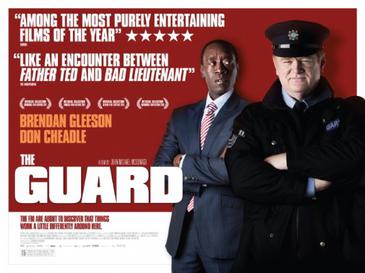
An Emperor Only Partially Clothed: Review of The Guard (dir. John Michael McDonagh, starring Brendan Gleeson)

File:THEGUARDposter.JPG

Good Irish films are like buses in that you wait for ages for one to come along, but that's where the similarity ends - what usually happens is, when the film does come along, it turns out to be rubbish. The Guard has got a lot of positive advance press, a big hit at Sundance, apparently. Writer-director John Michael McDonagh is certainly confident in his movie, otherwise he wouldn't risk such comments as: "A lot of Irish films fall by the wayside, mainly because they're rubbish."

The Guard obviously invites comparisons with In Bruges, one of the last Irish films to be greeted with any widespread enthusiasm: both are comedy noir, violent and irreverent, and both star Brendan Gleeson. And, of course, it was McDonagh's famous playright brother Martin McDonagh who wrote and directed In Bruges. Gleeson's character is on the other side of the law here - he's a guard, duh - but otherwise he's a similar character. He's a maverick cop, a renegade, a loose cannon - the only type of cop they make films about. He's at once debauched and sanctified - he likes hookers and coke, but he can't be bribed, and he can discuss Dostoyevsky. The film works by playing off the two sides of Gleeson's Sergeant Boyle, using Gleeson's lived-in and expressive face to get across the ambiguities of the character.

The other main character is less ambiguous, Don Cheadle's cardboard cut-out straight man, FBI agent Wendell Everett, who has no life of his own beyond reaction with surprise- amusement- exasperation or whatever to Boyle's shenanigans. Boyle's mother is played by respected actress Fionnuala Flanagan, and her character also lacks substance, completely based on the rude-remarks-are-funny-when-made-by-old-people idea. Not original, and Flanagan doesn't deliver the orgy and drug-taking jokes with much gusto. Also not original is the scumbag-crooks-who-discuss-weighty-intellectual-matters idea, which comes in in the portrayal of the drug dealers, who we find discussing Schopenhauer and Neitzsche, or at least quoting them, though the suspicion is it's just name-dropping, as nothing relevant to either of those philosophers is actually said. The intellectual name-dropping, both by the crooks and by Boyle, comes across as half-baked, as at no point do any of them evince any real familiarity with the subjects they're talking about.

The most jarring moment for me came with Boyle's response to being called a fool by Everett: "You didn't know people in the West of Ireland speak Irish, and I'm the fool!" I submit that no person from the West of Ireland would ever make the general statement that "people in the West of Ireland speak Irish", simply because it's not true.

Then there's the end. The wishy-washy, nothing-y, lazy ending. I suppose if you wanted to be polite you could call the ending "ambiguous", but I don't, so I'll say it: the ending was rubbish. It didn't cohere with the rest of the film. The film wasn't set up in such a way as to make such an ending acceptable. It was a real damp squib, ending not with a bang but with a whimper.

Looking back over my review, I may have given the impression that I disliked The Guard. Damn, I always do that. In fact, it was a generally enjoyable watch, some nice dialogue, excellent central performance by Brendan Gleeson. Worth seeing, yes. But not The Great Irish Movie, or a great Irish movie, or a very memorable movie. Some work on the script could, I think, have made this a considerably better film. Some less facile characterisations for all the characters bar Sergeant Boyle would have helped. But Gleeson pulls it through, and having just been awarded funding for his adaptation of Flann O'Brien's At Swim-Two-Birds, it could be an excellent year for this great actor (I wonder who he's playing in At Swim. The Uncle, I suppose). But I digress. I hereby award The Guard 7\10.

Monday, 13 June 2011

Bleak House - If It Was Emperor, It Would Be Naked

In recent times, the critical consensus has settled on Bleak House as Charles Dickens's masterpiece. The esteemed Harold Bloom, for example, cites it as Dickens's masterpiece in The Western Canon. According to The Oxford Reader's Companion to Dickens, BH received more critical attention in the second half of the 20th century than any other Dickens novel. This is quite an about-turn: I don't think anyone in Dickens's own time suggested BH was his best work. Rather they seemed most of all to enjoy the farcical humour of early Dickens, especially his first novel, The Pickwick Papers (1836-37), with Martin Chuzzlewit (1842-43) and David Copperfield (1849-50) also scoring high. An early example of "I prefer the early stuff", perhaps? In fact, Dickens's imaginative decline was often dated from Bleak House (1852-53) onwards. And it's clear to a reader even now, that something happened to Dickens between finishing Copperfield in 1850 and beginning BH two years later. The former is basically joyful and exuberant, the latter bitter and dark (though Dickens's notorious sentimentality is fairly equally prevalent in both), and with a marked emphasis on social and political satire.

Henry James, for example, was among the critics who thought Dickens lost it after Copperfield. In a 1865 review of Our Mutual Friend, James wrote: "For the last ten years it seems to us that Mr Dickens has been unmistakably forcing himself. Bleak House was forced. Little Dorrit was laboured, etc." This was a fairly standard criticism, but later critical opinion has reversed it: Pickwick Papers and the other early novels are no longer much read, but the later novels are treasured for their seriousness of purpose. Dickens was once read for fun, but nobody wants fun from Dickens anymore. And read Bleak House, and not-fun you shall certainly get.

Because Dickens is a classic, part of the canon, farcical humour and whimsy is incongruous with our expectations. We now read him to be edified, educated, to have our mind broadened, to commune with a great mind, and, to course, to have read Dickens. If Mark Twain hadn't said "A classic is a book that everybody wants to have read, and nobody wants to read", then I certainly would have, but he did, so I can only repeat it.

We want to feel like we've read something important, something BIG. Not a romp, this is serious business. A great novelist can be funny and entertaining as a by-product, but these do not produce greatness. If we call him great - and we have to, because he's 141 years dead and still widely read and some of his stories universally known - we have to justify it under more serious criteria. Bleak House is perhaps the easiest of Dickens's books to take seriously. It's very long, obviously; it can be seen to be tackling important social issues; it is plotted, rather than rambling, like Pickwick Papers, et al.; and it takes itself seriously.

We can read Bleak House and then we can talk about the treatment of the poor in Victorian London, about the operation of the legal system, about the treatment of illegitimate children. It no longer matters to us whether Dickens's critiques were accurate or relevant or not, because that society is gone, and only the book is left. Some of Dickens's contemporaries considered him a singularly ill-informed social critic: "he seems to get his first notions of an abuse from the discussions which accompany its removal" said Fitzjames Stephens in 1856. But now, it's not the accuracy that counts, it's the intent: Is it serious? Is it ambitious? Is it grand in scope?

Yes, BH is all of those things. But is it an enjoyable read? I'd have to say no. It's long-winded, it's dry. Its first-person narrator, Esther Summerson, is insufferably annoying, and its third person narration is stilted and all in the present tense. Just for comparison, let's take the opening lines from Bleak House, and then the opening of David Copperfield. The contrast is notable.

Bleak House:
LONDON. Michaelmas Term lately over, and the Lord Chancellor sitting in Lincoln’s Inn Hall. Implacable November weather. As much mud in the streets as if the waters had but newly retired from the face of the earth, and it would not be wonderful to meet a Megalosaurus, forty feet long or so, waddling like an elephantine lizard up Holborn Hill. Smoke lowering down from chimney-pots, making a soft black drizzle, with flakes of soot in it as big as full-grown snow-flakes — gone into mourning, one might imagine, for the death of the sun. Dogs, undistinguishable in mire. Horses, scarcely better; splashed to their very blinkers. Foot passengers, jostling one another’s umbrellas in a general infection of ill-temper, and losing their foot-hold at street-corners, where tens of thousands of other foot passengers have been slipping and sliding since the day broke (if the day ever broke), adding new deposits to the crust upon crust of mud, sticking at those points tenaciously to the pavement, and accumulating at compound interest.

David Copperfield:
Whether I shall turn out to be the hero of my own life, or whether that station will be held by anybody else, these pages must show. To begin my life with the beginning of my life, I record that I was born (as I have been informed and believe) on a Friday, at twelve o'clock at night. It was remarked that the clock began to strike, and I began to cry, simultaneously.


In consideration of the day and hour of my birth, it was declared by the nurse, and by some sage women in the neighbourhood who had taken a lively interest in me several months before there was any possibility of our becoming personally acquainted, first, that I was destined to be unlucky in life; and secondly, that I was privileged to see ghosts and spirits; both these gifts inevitably attaching, as they believed, to all unlucky infants of either gender, born towards the small hours on a Friday night.


On my first reading of Copperfield, I was immediately drawn in by the tone of these opening lines. The several instances of elegant and unobtrusive wit, particularly concerning the "sage women". The opening of Bleak House is, obviously, very different. It's in the present tense. The verbs are all gerund. It's heavy, man. Really hard to read. It doesn't rise above the murk it's describing, seeming to be infected with the lethargy of the London scene. To me, the lines from Copperfield just pulse with a life and energy that's missing from those of BH -  and from most of that book, in fact.

And, of course, the humour's missing. But BH's lack of humour has served it very well among modern critics. I do verily believe that if BH had been a more chucklesome read, that would have counted against it among the criterati. The absence of that characteristic is part of the reason people can talk about the novel as a comprehensive state-of-the-nation tract. For people who want to have read a classic, it's not important that the work produce an emotional reaction, but that its greatness can be rationalized: Bleak House produces far less emotional reaction than other Dickens books, but it can be neatly rationalized as great because of its scope, its seriousness of intent and its social criticism. But if you want to really understand why Dickens was a massive phenomenon whose books affected people in ways probably no other writer has matched, I don't think BH gives the best picture.


Carey Mulligan as Ada in Bleak House, 2005


On the plus side, the BBC made in 2005 a serial of BH, for those who want to encounter a classic, but not to have to read it - I'm serious, I'm almost certain that was why it was made. It's very faithful, so you can watch it, then pretend you've read it. It's no more engrossing than the book, in my opinion, but it got an excellent reception, so what do I know? It's just I think that the exaltation of BH is doing Dickens a disservice, because it doesn't showcase him at his best, just at his most "literary".

Gillian Anderson as Lady Dedlock, wearing that lemon-sucking face she kept up FOR THE WHOLE SERIAL WITHOUT A SINGLE DEVIATION.


Concluding Note:
That said, almost all of Dickens's books are deeply flawed. The only one that is mostly uninfected by Dickens's unctuous sentimentality is Great Expectations (1860-61). This late novel doesn't seem to have been among the most popular in Dickens's lifetime, either, though it has proved among his most enduring. In this case, I think it's deserving of the accolades. But the best of the best of Dickens is found, in my opinion, in David Copperfield, particularly the early chapters. Sadly, there's some cringingly awful stuff in there, too, but at its best it has a power that Bleak House doesn't come close to matching.


Monday, 6 June 2011

Bob Dylan - A Sloppy Lyricist

The most recent edition of Rolling Stone magazine has Bob Dylan as its cover star. It is his 70th birthday, after all, so what better time to celebrate his unique contribution to popular music in the second half of the 20th century and to indulge in unrestrained eulogizing of the great man's songwriting. The Rolling Stone piece opened with "All sorts of people can write a great song. It took Bob Dylan to rewrite our idea of what a great song can be." Even more generously, they described Dylan's 2003 film Masked and Anonymous as "underappreciated", when really anything short of scornful ridicule is overappreciation where this turkey is concerned.

The thing about much of Dylan's most acclaimed work is that it is so oblique of meaning that it's hard to judge. Is "Desolation Row" a wide-ranging state-of-the-world address or a string of broken images? Did Dylan's innovation consist in a facility with juxtaposing unexpected images or was he engaging with something beyond his own mental processes?

Some of Dylan's writing is rather sloppy and lazy, undoubtedly. One example of this for me is in "All Along the Watchtower", one of Dylan's most famous and most covered songs. The last lines go:

Outside in the distance a wildcat did growl
Two riders were approaching, the wind began to howl.

Hendrix's version, as Dylan's isn't on YouTube.

It's always struck me that a wildcat growling in the distance is not what Dylan actually means. A growl doesn't carry, and a distant one would be inaudible. What he actually means is that the wildcat howled, but he can't put that in, because the next line ends in howl. So he sticks in growl because it rhymes. Problem solved, but when you think about it, it doesn't make sense, and may cause you to wonder just how much Dylan was paying attention to his words.

It's also worth noting the criticism folk musician Dave van Ronk made of the title of "All Along the Watchtower": "a watchtower is not a road or a wall, and you can't go along it." Spot on. Van Ronk strikes a blow for the pedants among us.

Or how about in "One More Cup of Coffee" from 1976's Desire. Specifically the line "Her eyes are like two jewels in the sky". I guess Dylan was taking his influence here from children's rhyme "Twinkle Twinkle Little Star", which shines "like a diamond in the sky". The children's rhyme makes sense: the little star is in the sky, and it shines like a diamond.

Dylan's version not available on YouTube, so I went for Roger McGuinn's (and Calexico).

But Dylan's line doesn't make sense. Her eyes are like jewels in the sky? What are jewels in the sky like? Perhaps her eyes shine like jewels, but why do they have to be jewels in the sky? Are her eyes "in the sky"? Again, I think it's just sheer carelessness. The image is childish enough as it is, but also totally nonsensical.


I've always been puzzled, too, by the line in "Just Like A Woman": "When me meet again, introduced as friends". How can two people be introduced as friends? "Hey, Bob, this is Edie [or whoever]. You two are friends." Does he mean introduced by friends? That would make sense, especially in the context of the next line: "Please don't let on that you knew me when I was hungry and it was your world."

Or how about "Tombstone Blues" from Highway 61 Revisited. It includes the lines:

The hysterical bride in the penny arcade
Screaming she moans, “I’ve just been made”

This implies simultaneous screaming and moaning. She moans "I've just been made" while screaming. This is of course, impossible.

Dylan's version of this isn't available either (damn, his record company is assiduous in preventing free access to Dylan tracks), so I've gone with Richie Havens's.

At this point, the extreme pedantry of my complaints may have irritated some. All I can say is that this is quite important, for me, and revealing of a guy who's writing from the top of his head and isn't paying attention to what he's saying, because sometimes he's not saying anything. I find it offputting to listen to lyrics where one comes across such evidence of the writer not bothering to express himself properly. And they're asking for the Nobel Prize for Literature for this guy? I'm afraid I'd have to demur: powerful as his compositions, at their best, are, on the printed page their faults are more clear, so as literature they're not worthy of such an accolade.

Thursday, 2 June 2011

Voice of a Generation Syndrome: Alex Turner and Bob Dylan

Alex Turner has been talked up as a "voice of the generation" type lyricist since the Arctic Monkeys' debut appeared in 2006, and it's no surprise to hear that he isn't that comfortable with the description. "I just don't think I'm equipped to soundtrack the times," he insistsed in a recent interview with the Observer Magazine. And so his more recent lyrics have moved in the opposite direction, all of his lyrics on new album Suck it and See are love/ relationship songs, but it's a mystical and somewhat surreal sort of love. What with the topless models doing semaphore, the wrecking ball gown in the damsel-patterned alley, and the library pictures of the quickening canoe, the unexpected juxtapositions of Turner's Suck it and See lyrics are reminiscent of Dylan's mid-60s output. You know, "The sun's not yellow it's chicken", or "The ghost of electricity howls in the bones of her face." That sort of stuff. They just lapped that shit up in the 60s.

- "Absolutely Sweet Marie", from Blonde on Blonde, 1966. Dylan at the height of his "here's some deep shit off the top of my head" period. Persian drunkard, check. Yellow railroad, check. Actually, there are better examples: "Tombstone Blues" and "Desolation Row" come to mind, but the Highway 61 Revisited songs aren't available on YouTube.


My point, really, is that Dylan's increasingly fractured, surreal and nonsensical lyrics came about as a reaction to the same thing. People were calling him the voice of a generation, even the voice of the civil rights movement, after "Blowin' in the Wind", "The Times they are A-Changin'", et al., and he had to get away. It didn't work, mind: Dylan's words were still taken as oracle. It was like that Life of Brian scene:
"I'm not the messiah"
"Only the true messiah would say he's not the messiah."
"All right, then, I am the messiah!"
"HE IS THE MESSIAH!"
John Lennon saw through it, though; speaking about The Beatles' famous masterpiece of gibberish, "I Am the Walrus", Lennon said: "Dylan got away with murder. I though, 'Well, I can write this crap, too.' You know, you just stick a few images together, you thread them together and you call it poetry."


Not comparing Turner to Dylan, or calling him the new Dylan, but he seems to have come down with a similar case of Voice of a Generation Syndrome, and that's why his new lyrics make about as much sense as a rat fucking a grapefruit, to quote Marlon Brando (talking about a film he was in). People were taking his small vignettes of teenage life in Northern England too seriously, and rather than become paralyzed by the attention, he's taken refuge in nonsense. To live up to people's impressions of his lyrical genius is next to impossible. He's learned an important lesson in a poet's education: IT'S MUCH EASIER TO SOUND IMPRESSIVE WHEN YOU'RE SAYING STUFF THAT DOESN'T MAKE SENSE. Try saying something that's true, but also that isn't trite or cliched. Can't do it, can you? So, repeat after me: "Library pictures of the quickening canoe, The first of its kind to get to the moon." Now that's what I'm talking about.


Thursday, 26 May 2011

Arthur Machen joins the Big Leagues in Penguin Classics

Once disreputable, then neglected, Arthur Machen is now set to join the hallowed ranks of writers included in the Penguin Classics series. A selection of Machen's stories will come out in Penguin in December 2011. Machen lived into the late 1940s, but the work of his still read today was written almost exclusively in the 1890s, though some of it took years before being published.


For those not in the know, Machen was a horror writer, his work being a prototype of cosmic horror. He was a big influence on H.P. Lovecraft, probably the big influence. He wrote some pretty far-out stuff, and had the distinction of being widely denounced for his early tale "The Great God Pan" (1894), called "the most acutely and intentionally disagreeable book yet seen in English" and "an incoherent nightmare of sex". It was predicted that "the majority of readers will turn from it in utter disgust". And maybe they did - it certainly didn't sell that well, but it went on to be massively influential in the horror genre.

In case you're wondering what was so disagreeable about "Pan", the story is set in motion by some guy identified as Dr. Raymond - though I have my doubts as to his accreditation with the medical council- who wants to access hidden realms of sensation and discovers a form of brain surgery which allows him to do so. Having a compliant young lady at hand, he performs on her this unspecified operation, thus lifting the veil from her perception, as it were, and bringing her face to face with a primal life-force beyond what civilized man can experience. "The ancients called it seeing the god Pan", according to Dr. Raymond. Anyway, the young lady, Mary, ends up after the op a gibbering idiot, but nine months later she gives birth. That is, she hasn't just seen the Great God Pan, she's gotten a lot closer than that, and it's destroyed her mind.

Disgusted yet? That's just the first chapter, about 8 pages: as for the rest of it, suffice to say that fearful powers have been let loose, powers that wish to drag mankind down to the level of beast. The ideas underlying the story revolve around mankind being divorced from the true nature of life, and that if he came face to face with this, personified by Pan, his mind would be shattered and he couldn't live. At the bottom of existence is a well of ultimate horror, which we have covered up with our veneer of civilization, and woe betide the man who scratches that veneer.

Machen was apparently a life-long devoted member of the Anglican church, despite the blasphemous overtones of "The Great God Pan". Ultimately, the story is founded on a sense of repulsion toward the unregulated self, and a belief in the civilizing process as an unqualified good, and very necessary. On the other hand, there's an obvious fascination with the more animalistic side of human nature, a deep morbidity that permeates much of Machen's work.

As it happens, "The Great God Pan" doesn't appear to be included in Penguin's collection, which is odd as it's probably his most influential work. Recently, Stephen King called it "one of the best horror stories ever written". Lovecraft said of the story "no one could begin to describe the cumulative suspense and ultimate horror with which every paragraph abounds".

The foreward for the Penguin collection is to be written by no less a personage than Guillermo del Toro, long-time Machen fan and director of Pan's Labyrinth, Hellboy, The Devil's Backbone, etc. Editor of the collection Sam Joshi admitted in his blog that it was del Toro's involvement that swayed Penguin towards green-lighting the Machen project.

The collection is to be called The White People and Other Stories and will include "The Inmost Light," "Novel of the Black Seal," "Novel of the White Powder," "The Red Hand," "The White People," "A Fragment of Life," "The Rose Garden," "Witchcraft," "The Bowmen," "The Soldiers' Rest," "The Great Return," "Out of the Earth," and "The Terror".

Slightly more of a leaning towards Machen's less highly-regarded later work here than in other collections, the last 5 stories being from the 1910s and 20s. "The Great God Pan" is the most notable absentee.

"The White People" is given the honour of titling the collection. This story concerns a young girl who communes with unearthly spirits in a Welsh woodland, on the site of an old shrine dating back to the Roman occupation, which still apparently retains traces of a supernatural power. The story is narrated by the young girl herself, so happenings are presented in a manner not entirely clear, however Machen seems to be once again implying some sort of sexual union between girl and... something unnameable. Yeah, he was really into that. This story was written in 1897, but not published until 1904, when it failed to garner much interest, not even replicating Pan's dubious achievement of being widely denounced. Lovecraft, though, gave this story pride of place among Machen's works, higher even than Pan (see Lovecraft's long essay "Supernatural Horror in Literature").

None of these stories of Machen's have ever been filmed. The only full-length film of a Machen story is from Mexico, El Esqueleto de la Senora Morales, from a little-known 1927 story, "The Islington Mystery". Then, there was a British TV version of 1895 story "The Shining Pyramid". "The Shining Pyramid" is another slightly surprising omission from Penguin's collection. It posits a group of sub-human "little people" living under the ground in rural Wales (Machen was Welsh, hence its frequent use as setting for his tales of the weird) who are rarely seen by humans, and if you do see them, that's bad, as it probably means they're planning to use you in one of their horrible rituals, as memorably described here. It's a quintessential Machen tale.

Machen is a cult figure, and will probably remain so, but his influence on people like King, del Toro and Lovecraft indicate his importance. He was also a favourite author of Mick Jagger in the 1960s, apparently. If you liked The Wicker Man, the classic 1973 British chiller (NOT the 2006 remake), then Machen is a guy you should look at. Read him, if you dare lift the veil and confront the horror that lies at the core of life, the hideous bestiality that is the life force, seething beneath your civilized exterior. After reading, you should of course replace the veil immediately, lest you be visited by some lustful embodiment of the world of nature, a world we have forgotten but not quite left behind. Because you don't want such a visitation - that wouldn't be pleasant at all.


The Penguin collection isn't out yet, but plenty of good alternatives exist, like the volumes from Chaosium Press, also edited by Sam Joshi:


"When the house of life is thrown open, there may enter in that for which we have no name, and human flesh may become the veil of a horror one dare not express." - Arthur Machen.

Monday, 23 May 2011

Arctic Monkeys - Contemporary Purveyors of the Quality B-Side.


Certain bands were masters of the art of the b-side: The Beatles, for example, and later The Jam or The Smiths. Most bands, though, just chuck any old crap on there, some live cover, maybe, or, gravest sin of all, an album track. God forbid a half-decent song should be wasted on a b-side – it’s about as likely as a band donating a good song to a charity album. Yet still flying the flag for the b-side as actually decent song is one band, Arctic Monkeys. In their six year recording career they’ve hardly released a bad b-side. Maybe in a few years they’ll release a compilation of them and sell millions, but at the moment these b-sides are a secret code, known only to the initiatived, to those who really get it, but not to the great unwashed of the music-listening world. But perhaps it’s time that all the world should know it.

It was there from the beginning: the b-side of the Monkeys’ breakthrough debut single “I Bet you Look Good on the Dancefloor” was a little ditty called “Bigger Boys and Stolen Sweethearts”, which sees a doleful Alex Turner lament that “There’s always somebody taller with more of a wit, And he’ll be quick to enthrall her and her friends think he’s fit.” It’s about the type of guy who’d “pinch your bird and probably kick your head in.” You know the type. It’s a beautifully-observed slice of teenage life, sensitive and funny. An auspicous start.

Follow up “When the Sun Goes Down” had “7”, which wasn’t half bad, either. Another of those early Monkeys songs about meeting girls in night clubs, or not meeting them in this case, because by the time our narrator gets the courage to speak, she’s gone.

Another high point was “Temptation Greets You Like a Naughty Friend”, b-side of “Brianstorm”, the first single from the band’s second album. This showed the Monkeys’ new tougher sound, and Turner’s lyrical approach, or at least the persona he adopted in his lyrics, had also changed a lot. Now he’s not worried about his bird getting pinched; he is a famous rock star, after all. Instead, it’s “I don’t ever want to hate you, So don’t show me your bed.” Dizzie Rascal also shows up mid-song for a rap. This is probably the Monkeys’ best known b-side; at least, a quick search on YouTube seemed to indicate this had more views than any other of their b-sides.

Second Favourite Worst Nightmare single "Flourescent Adolescent" was backed with “Bakery”, “Plastic Tramp”, and “Too Much to Ask”, and third single “Teddy Picker” with “Bad Woman”, “Death Ramps”, and “Nettles”. All fine tunes.

Then 2009’s Humbug, the album that somewhat put the brakes on Arctic Monkeys’ meteoric commercial rise. First single “Crying Lightning” immediately showed this was a different Arctic Monkeys. Weird, spidery riff, lyrics that didn’t make a whole lot of sense. Some sweet metaphor: “My thoughts got rude as you talked and chewed on the last of your pick and mix.” Mmm-hmmm, okayy... B-side was a cover of a 1994 Nick Cave song, “Red Right Hand”, with a lyric about some sort of demonic figure with a right hand of the colour mentioned. The single also included “I haven’t got my Strange”, only 1 minute 30 seconds long. Like a lot of Monkeys’ songs from the period, it has a slightly twisted vibe and, again, lyrics that are hard to fathom.

Second single “Cornerstone” had an excellent b-side in “Catapult”. The character described in “Catapult” recalled the Brian of “Brianstorm” or the bigger boy of “Bigger Boys and Stolen Sweethearts”, maybe even the diabolic figure in “Red Right Hand”. He’s an irresistibly charming user, whose effect on the opposite sex is extraordinary: “They queue up to listen to him pissing/ And hang around to watch some poor girl blub/ And then they chase him down the avenue/ Incessantly pestering him to let them join the club.” The single also contained 2 extra tracks, no less: “Fright Lined Dining Room” and “Sketchead”, the latter lyrically close to “Catapult”, yet another portrait of a predatory male who always gets his way: “There’s poison in his spit, he’ll compliment your tits and leave you to your wits – Sketchead/ Convincingly insisting the tyres were bald when you gave him the car.” Another good song, though; you definitely got your money’s worth with this single. The final single from Humbug, “My Propellor”, was backed with “Joining the Dots”.

Arctic Monkeys have an excellent track record with b-sides, and if they ever release a compilation, which I’m sure they will, I’ll be right down to the record store with a 10-bob note in my grubby fist – till then I’ll just listen to them on YouTube. But now, with new album Suck it and See due out in a couple of weeks, is a time to look back on their catalogue and see there’s a lot of good stuff there, hidden away in dusty corners. Hopefully, the new b-sides hold up the proud tradition, and continue putting all those lazy bums with their live versions or already released b-sides to shame. Shine on, you crazy monkeys!

Full Arctic Monkeys Discography